

Q&A: What is Long-Range Transmission Planning and Why is It Important?
 | Elizabeth Wheeler, Senior Counsel, Director of Regulatory Advocacy |
 | Alex Thompson, Communications Associate |
| Elizabeth Wheeler, Senior Counsel, Director of Regulatory Advocacy |
| Alex Thompson, Communications Associate |
Q: I’ve been seeing this acronym pop up everywhere: LRTP. What does it mean? And what is this “Tranche 1” I keep hearing about?
These terms both refer to the regional buildout of transmission lines that are needed to deliver electricity to homes and businesses in our region. Our regional transmission operator, MISO, studies what the probable future transmission needs are for our electricity system (i.e., the “grid”) and then uses that data to determine optimal solutions that provide the greatest benefit at the least cost. This process is called “Long-Range Transmission Planning,” or “LRTP” for short.
In 2021-2022, MISO’s planning process identified significant issues with our transmission system. MISO undertook a multi-phase process to address these shortcomings in smaller, more manageable portfolios of upgrades that will spread the work and cost over several years. “Tranche 1” refers to the first portfolio of these LRTP projects.
Q: Sounds expensive. Who pays for it, and is it really worth it?
LRTP is made up of “multi-value projects,” or “MVP” for short. MISO’s rules spread the cost for MVP projects across the region because the projects bring significant regional benefits that are not bound by specific utility service territories or state boundaries. So, while the price tag for the Tranche 1 projects seems large, because the costs are spread across so many states and users who are benefitting from the transmission services, the per-user cost is quite low.
Another thing to keep in mind is that the Tranche 1 lines bring huge benefits to the region in terms of reliability, relieving grid congestion, access to lower-cost generating resources, diversification of our energy mix, and emissions reductions. Together, these benefits result in over $37 billion in economic benefits to the Midwest over the next 20 years.
Projects must provide more benefits than costs in order to be considered an MVP. The Tranche 1 portfolio offers a benefit-cost ratio of 2.6:1.
Q: Why do we need to build these new transmission lines in the first place? Why can’t we just update existing infrastructure?
Some of the Tranche 1 projects are updates to existing infrastructure but allow for future expansion that will deliver cleaner and less expensive electricity into our region. For example, where Tranche 1 projects are upgrading a 161kV line to a 345kV line (a common upgrade in the Tranche 1 portfolio), the new line will be able to carry roughly 4.6 times more power than the existing one. In many cases, the new lines will also be built to accommodate future double-circuiting, which simplifies future upgrades that can double the capacity of the line.
Q: How much progress has been made on Tranche 1 so far? Have these lines been built yet?
MISO approved Tranche 1 in December, 2022, but each project still requires state and local approvals. Most of the states where the Tranche 1 lines are proposed require a certificate of need and/or a siting permit for large transmission lines. So, the developers of these lines had to apply for these permits through their state’s public utility commissions (save for Indiana, which does not require this). As of December 1, at least one Tranche 1 project has received approval in every state that requires it (CGA submitted expert testimony to support the projects in Michigan, Illinois, Wisconsin, Iowa, and Minnesota). Once state permits are approved, construction can begin – but the in-service timeline for the entire Tranche 1 portfolio isn't until 2030. This is why advance planning for transmission is so important – building these projects can take several years, even under the best conditions.
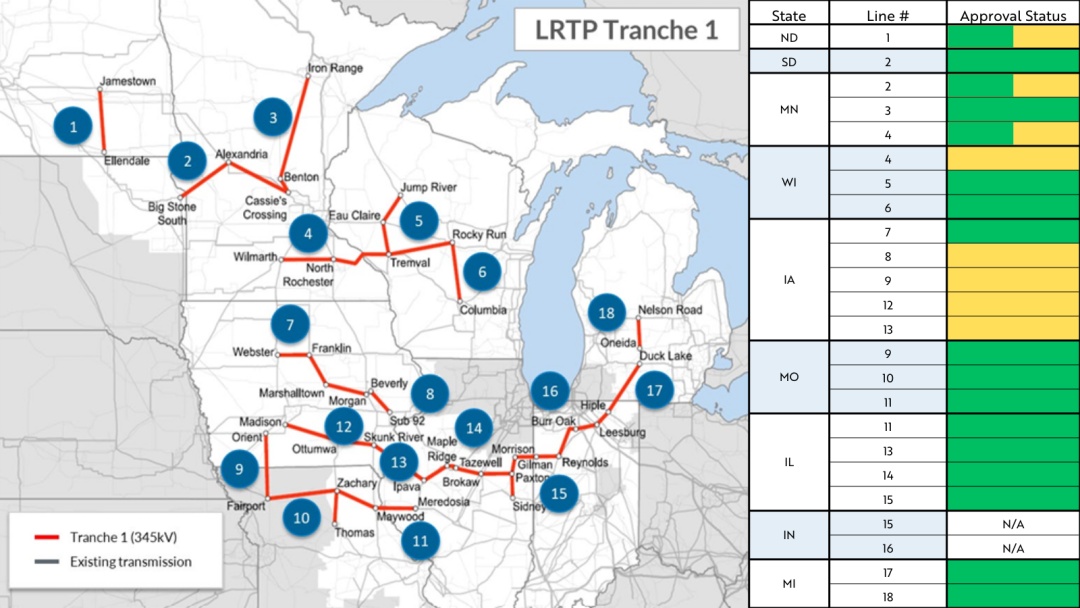
*Approval statuses as of December 16, 2025. Some projects are partially approved, as shown in the "Approval Status" column. For example, a project could have approval for its Certificate of Public Convenience and Necessity but not yet have approval for its Route Permit.
Q: What’s next? Have there been any lessons learned through the Tranche 1 process that we can use for future transmission planning?
MISO is continuing its LRTP process and approved a second portfolio, known as “Tranche 2.1” in December, 2024. Tranche 2.1 represents 24 projects totaling over 3,600 miles of regional transmission projects and includes a 765kV “backbone” that will significantly improve the flow of electricity across the grid. These 765kV lines can carry six times the capacity of a 345kV line, providing an efficient solution that minimizes the need for new lines in the future. The $21.8 billion portfolio has a cost-to-benefit ratio of 1.8-3.5 with benefits potentially exceeding $72 billion.
Tranche 2.1 will help meet the swell of new energy demand that was unanticipated back when Tranche 1 was approved. These transmission lines will provide needed grid stability while delivering billions of dollars in economic benefits.
The Tranche 1 permitting process has been largely successful across the region, demonstrating the strong collaboration that is possible among developers, regulators, and local stakeholders. A few sticking points emerged around siting, routing, and landowner notification, and in the case of Michigan, prompted the state public utilities commissions to open a new docket to clarify and strengthen siting and application guidance ahead of the Tranche 2.1 projects. Building on the lessons of Tranche 1, transmission developers have an opportunity to continue engaging early and often with the communities along proposed routes, ensuring transparency and meaningful participation for all stakeholders from the outset of the Tranche 2.1 process.
The Bottom Line
The Tranche 1 portfolio shows why regional transmission planning matters. By looking ahead and planning at a regional scale, MISO identified projects that strengthen reliability, reduce congestion, lower costs for consumers, and unlock access to cleaner, more diverse energy resources, all of which will result in $37 billion in benefits over the 20 years. With projects approved across the region and permitting well underway or complete in every required state, Tranche 1 has seen tremendous progress over the last year, laying a strong foundation for the next phase of transmission investments needed to power the Midwest’s energy future.
Additional resources:
Alex Thompson joined CGA in October 2023 as a Communications Associate. He maintains external communication channels including blog posts, social media, fact sheets, newsletters, and podcasts.
